

Description
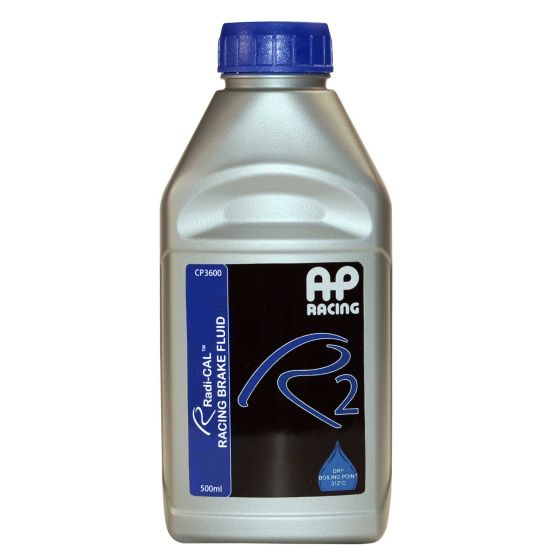
AP Racing Radi-Cal R2 (Formerly 600) racing brake fluid is developed for racing applications where high temperatures are being experienced. With a dry boiling point exceeding 300 degrees C it is suitable for all forms of Motorsport. Very high dry boiling point (312°C)
High wet boiling point (195°C)
Suitable for the demands of Motorsport use
Conforms to and exceeds DOT4 specification. Radi-Cal R2 brake fluid is compatible with other DOT4 fluids but for maximum performance it is recommended that the braking system should be drained completely and purged with R2 fluid prior to re filling.
‘Typical’ Boiling Points.
- New Dry 312°C
- ‘Wet’ E.R. 195°C
500ml Bottle
To view the AP Catalogue, click Here
Servicing & Replacement Guide
Wet-fluid performance: Dissolved water reduces the boiling point of glycol-based brake fluids. AP Racing lists R2’s typical new dry boiling point as 312°C and wet equilibrium reflux boiling point as 195°C. The wet figure is not a measurement of the fluid currently in your system.
Before each race event: For best racing brake performance, AP Racing recommends thoroughly bleeding the system immediately before each event using fresh fluid from a new sealed bottle. This is particularly important in wet or humid conditions, or when the brakes are excessively hot. High-temperature fluid is not a substitute for proper brake cooling.
Fresh fluid, not reused fluid: Always use fresh fluid, replace the bottle cap when not in use, and never reuse drained brake fluid. AP Racing recommends an 18-month shelf life for unopened bottles; this is a storage limit, not an in-service replacement interval. Colour variations can occur during R2 manufacture and do not affect its quality or performance.
Compatibility & servicing advice: R2 is intended for competition use only and must not be used with magnesium components. It can be mixed with DOT4 racing brake fluids, but AP Racing recommends thoroughly purging the system with R2 for maximum performance. Consult your race or vehicle manufacturer for system-specific inspection, bleeding and full-replacement requirements, or if you are unsure about compatibility or brake cooling. Do not apply a universal mileage or time-based replacement interval.